
ABSTRAK
Food is a basic need for humans living on this earth that is needed at all times. The food consumed should meet the criteria that this food is suitable for eating and does not cause disease. The way food is prepared, the hygiene of food handlers and how it is served are all important parts of food management. Foodborne illness is one of the leading causes of morbidity and mortality in Indonesia. Some of the factors that influence personal hygiene in food handlers are age, education level and knowledge level. 100% of food handlers’ behavior is not washing hands with soap when starting work, hand habits when transitioning from food management and buying and selling transactions. Food handlers do not use personal protective equipment such as work clothes, gloves and kitchen footwear.
Keywords: Personal Hygiene, Food Handler Behavior, Healthy Food
INTRODUCTION
Food is a basic necessity for humans living on this earth that is needed at all times. Food requires good and proper management to benefit the body. According to WHO, what is meant by food is “Food include all substances. whether in natural state or in a manutactured or preparediood. which are part of human diet.” The definition of food does not include water. medicines and substances required for medicinal
purposes. The food consumed should meet the criteria that it is fit to eat and does not cause disease.
Personal hygiene Self-care is an effort made to maintain one’s cleanliness and health, both physical and psychological well-being, while lack of self-care is a condition in which a person is unable to perform hygiene care for himself (Potter & Perry, 2005). In carrying out daily life, cleanliness is very important and must be considered because basically cleanliness will affect a person’s health and psychology. Individual values and habits that a person often does will affect hygiene for himself. A person’s perception of cleanliness will affect their health, for example when a person is sick it usually happens because he does not maintain cleanliness and considers cleanliness a minor problem.
Maintenance of personal hygiene is necessary for individual comfort, safety and health. Healthy individuals will be able to fulfill their health needs, while sick individuals need the help of nurses or other people to carry out routine health practices (Perry & Potter, 2005).
The impact of personal hygiene consists of psychological impact and physical impact, where the physical impact is the presence of health problems suffered by someone because they do not maintain good personal hygiene (Ambarawati & Sunarsih, 2011).
Infectious diseases are diseases that can be transmitted from individuals to other individuals either directly or indirectly (intermediaries) (Natoadmodjo, 2003). Various infectious disease agents can be transmitted through water, including viruses, bacteria, protozoa, and vectors that make the water environment their residence. According to the way of distribution, Water Washed Disease, Water Borne Disease, Water Related Vectors (Priyanto, 2019).
Susanna (2003) in Agustina, et al (2009) said that diseases caused by contaminated food are called foodborne diseases. Foodborne diseases are one of the most numerous and most burdensome public health problems ever encountered in modern times.
Furthermore, Adam. M (2004) in Cahyaningsih, et al (2009) also said that food handler behavior plays a role in determining whether a food is healthy (healthy food) or not, food handler behavior can also pose a health risk. This means that unhealthy food handler behavior will have an impact on the hygiene of the food served. Conversely, healthy food handler behavior can prevent food from contamination or pollution and poisoning.
Not maintaining sanitation and personal and environmental hygiene will be associated with several infectious diseases such as diarrhea, cholera, typhoid and paratyphoid fever, dysentery, hookworm disease, ascariasis, Hepatitis A and E, skin diseases, trachoma, schistosomiasis, cryptosporidiosis, malnutrition, and diseases associated with malnutrition.
Based on the above background, we are interested in writing a study on healthy food safety in terms of personal hygiene and sanitation in food handlers in the FKM UNSRI canteen.
The purpose of this paper is to determine the application of personal hygiene to food handlers in the FKM UNSRI canteen.
METHODS
The research was conducted on October 25, 2023 at the canteen of the Public Health Science Study Program, Faculty of Public Health, Indralaya, Sriwijaya University. The research was conducted using interviews and observations of food handlers as many as 4 canteen stands. Before the research was carried out, a measurement of the description of personal hygiene behavior of food handlers was carried out to determine the description of personal hygiene behavior of food handlers. This activity was carried out by students of the Public Health Science Study Program, Faculty of Public Health, Indralaya, Sriwijaya University.
RESULTS AND DISCUSSION
- Definition Food Handler
According to the NSW Food Authority (2011), a food handler is any person who works in a food business and handles food, or who is in direct contact with the outer surfaces of food (e.g. cutlery, plates).
- Risk Factors of Personal Hygene Food Handlers with Disease Incidence Food handlers are people involved in a series of food processing processes from preparing, cooking, cooling, preserving, reheating and serving food. Food handlers play an important role in the transmission of foodborne diseases. The problem of food borne diases is one of the problems caused by food handlers. Food handlers are linked to the incidence of disease as it relates to the personal hygiene of each handler. During food preparation, food handlers should maintain good personal hygiene to avoid food contamination. However, many food-related incidents occur due to food contamination caused by careless behavior of food handlers and failure to maintain personal hygiene and cleanliness while working.
Personal hygiene is a clean attitude of food handler behavior so that food is not contaminated. In this regard, the hygiene of individuals involved in food processing needs to be considered to ensure food safety and prevent foodborne disease transmission. Purnawijayanti, 2015 stated that 25% of all foodborne illnesses are caused by infected food handlers and poor personal hygiene (Fithri, 2016).
Based on the results of observations related to the personal hygiene of food handlers in canteen workers at FKM, it appears that there are still food handlers who do not perform personal hygiene and there are poor behaviors towards personal hygiene of workers, for example during the cooking process the worker’s hands are not only focused on when he cooks but holds other things that are around him which of course makes the hands not sterile anymore, and there are still many who do not use sanitation facilities such as not using aprons and head coverings
during the food processing process (Juhaina, 2020) (Mirawati, Sitorus and Hasyim, 2011) (Fauziah et al., 2020). , 2021).
- Food Handler Sterilization Habits
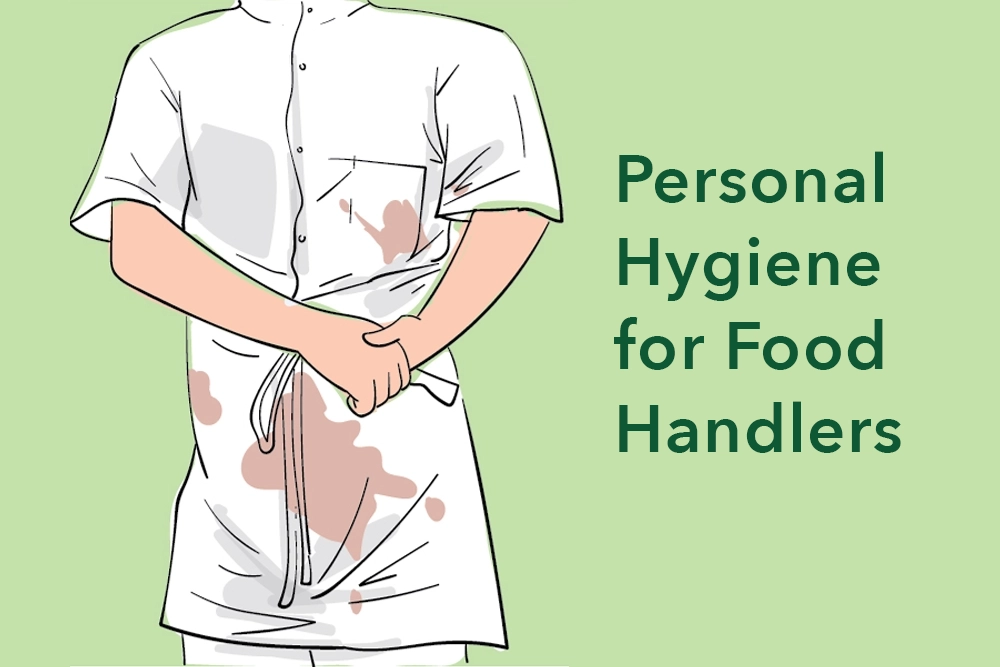
Food handlers at the FKM UNSRI canteen during processing and serving wear aprons. It’s just that in practice only a few of the food handlers use complete personal protective equipment (PPE).
Food handler sterilization habits 100% of food handlers do not wash their hands with soap when starting work, hand habits when transitioning from food management and buying and selling transactions. Food handlers do not use personal protective equipment such as work clothes, gloves and kitchen footwear.
According to Arisman on duty every food handler should wear an apron, hair cap, kitchen shoes, not smoke, not eat or chew anything and not wear jewelry. Bad behavior during food handling is still often seen such as coughing and sneezing, touching the nose, wearing jewelry, licking food with fingers during serving, almost all food handlers chatting during the processing process and most of the food handlers are still in direct contact with the body.
Food handlers should protect food by using intermediaries to separate food from anything that could contaminate it at all stages of food processing. Such intermediaries include gloves, hairnets, mouth covers and aprons.
According to Gaman & Sherrington (2006), personal hygiene sterilization of food handlers aims to avoid the spread of bacteria from the body or clothes to food ingredients. The key points of personal hygiene are:
- Hands
Hands should always be washed with warm water and soap every time you start food preparation. Avoid using towels as they can be a means of transferring bacteria from one person to another.
Appropriate hand washing times are after going to the bathroom, before and after handling chemicals, after taking out the trash, after cleaning dirty tables or
equipment, after handling clothes or aprons and after handling money (Gisslen, 2006).
According to Gisslen (2006), for handling foodstuffs, the use of gloves is highly recommended. The use of gloves can help to create protection between hands and foodstuffs. However, never use gloves in a handwashing station. Hands should be washed thoroughly first before using gloves.
- Outdoor clothing
Clothes used in the food preparation area must be clean. Avoid using clothes that are worn outside the food preparation area, especially those that are exposed to free air.
- Jewellery
Personal jewelry can harbor bacteria and may fall into food. Jewelry other than wedding rings should not be used at all.
- Food Layout
Food handlers at the FKM UNSRI canteen during the serving process wear an apron. It’s just that in practice only some of the food handlers use complete personal protective equipment (PPE).
Food serving must be done according to the type of food. Hot food must be placed in a container suitable for hot food, as well as for cold food. Food that is processed immediately, must also be served immediately after processing, especially for food that must be served hot. Food that is ready to be cooked should be placed in a food heater so that the heat is retained until it is served. Serve food covered for hot food. Meanwhile, cold food must be stored in a refrigerator before serving. Cold food also does not need to be covered if the place of serving is not far from the place of processing.
The cleanliness and control of food before serving can affect the health of the people who will consume it. Food contaminated with bacteria or harmful ingredients can cause poisoning and illness. There are three types of hazards caused by errors in food control: biological hazards, chemical hazards and physical
hazards. Biological hazards include bacterial and parasitic contamination that can cause disease. This pollution can be caused by air, soil, and water or small animals in a dirty environment. Not all food served will be eaten immediately, especially catered food. If it is not stored with food hygiene and sanitation principles before serving the food, it could be contaminated.
- Hand Habits during the Transition from Food Management and Buying and Selling Transactions
The competence of human resources (personal hygiene) is one of the main keys in food safety. Poor food handling has the potential to cause negative impacts on consumers of the food eaten. The part of the body that has the most contact with food is the palm of the hand, so it must always be kept clean.
In buying and selling transactions, there is a process of exchanging money, receiving and giving change. Food handlers should not be involved in these activities. Handling food and money together contributes to food-related public health incidents. Money can be contaminated with bacteria or microorganisms from free air or dust, contamination of hands holding money, droplets, counting money by holding saliva, and unsterile storage of money. Some groups of bacteria that can be found on money include Citrobacter sp., Mycobacterium lepirae, Salmonella sp., Escherichia coli, Staphylococcus aureus, Klebsiella sp, Streptococcus spp. and Pseudomonas aeroginosa. Awareness of possible health risks due to money handling when serving/preparing food is required. Therefore, food handlers should focus on the food handling process and the buying and selling transaction activities should be done by others to reduce the potential for contamination.
CONCLUSIONS
Some influencing factors on food handlers are age, education level and knowledge level.Food handlers in general have never attended a course on food sanitation hygiene, and have never received guidance and supervision from relevant agencies.
Handler behavior is 100% not washing hands with soap when starting work, hand habits when transitioning from food management and buying and selling transactions. Food handlers do not use personal protective equipment such as work clothes, gloves, aprons and kitchen footwear. Food handlers do not use personal protective equipment such as head coverings, work clothes, gloves and kitchen footwear.
ADVICE
It is expected that students of the Faculty of Public Health, can provide continuous training, education, and / or information related to personal hygiene to all food handlers or leaflet media related to personal hygiene of food handlers in the FKM UNSRI canteen.
Food handlers are expected to maintain Personal Hygiene when serving food, maintain behavior so that food is not contaminated, and wear personal protective equipment properly and correctly.
REFERENCES
Admin (2018). Teknik Penting dalam Penyajian Makanan. [online] Njajan.com. Available at: https://www.njajan.com/2018/02/penyajian-makanan.html?m=1 [Accessed 26 Oct. 2023].
cfns (2013). Pentingnya Personal Hygiene dalam Mewujudkan Keamanan Pangan – cfns.ugm.ac.id/id/. [online] Ugm.ac.id. Available at: https://cfns.ugm.ac.id/2020/07/20/pentingnya-personal-hygiene-dalam mewujudkan-keamanan-pangan/ [Accessed 27 Oct. 2023].
Dan, M. et al. (2013) ‘ANALISA KESADARAN FOOD HANDLER MENGENAI HIGIENE MAKANAN DAN HIGIENE PERSONAL DI HOTEL BINTANG 4 DI SURABAYA’, (2013).
Fauziah, M. et al. (2021) ‘Penyuluhan Personal Hygiene Untuk Faktor Risiko Penyakit Menular Pada Siswa Pesantren Sabilunnajat Ciamis Jawa Barat’, AS-SYIFA : Jurnal Pengabdian dan Pemberdayaan Kesehatan Masyarakat, 2(1), p. 55. Available at: https://doi.org/10.24853/assyifa.2.1.55-68.
Fithri, N.K. (2016) ‘Hygiene Dan Sanitasi Pada Penjamah Makanan Di Kantin Universitas Esa Unggul’, Jurnal Inohim, 4(2), pp. 43–48.
Indrawan, P.N. (2022) ‘Kontaminasi Bakteri Pada Uang Kertas : Systematic Review’, Archive of Community Health, 8(3), p. 496. Available at: https://doi.org/10.24843/ach.2021.v08.i03.p09.
Juhaina, E. (2020) ‘Keamanan Makanan Ditinjau Dari Aspek Higiene Dan Sanitasi Pada Penjamah Makanan Di Sekolah, Warung Makan Dan Rumah Sakit’, e SEHAD, 1(1), pp. 32–44.
Mirawati, M., Sitorus, R. and Hasyim, H. (2011) ‘Analysis of Personal Hygiene and Food Handling on Patients Food Managementt in Rsup Dr. Mohammad Hoesin Palembang’, Jurnal Ilmu Kesehatan Masyarakat, 2(1), pp. 45–53.
Author
- Khistian Damayanti
- Naurah Salsabila Lukita
- Liona Ayu Permata Kusuma
- Muhammad Faaiz Aqiilah